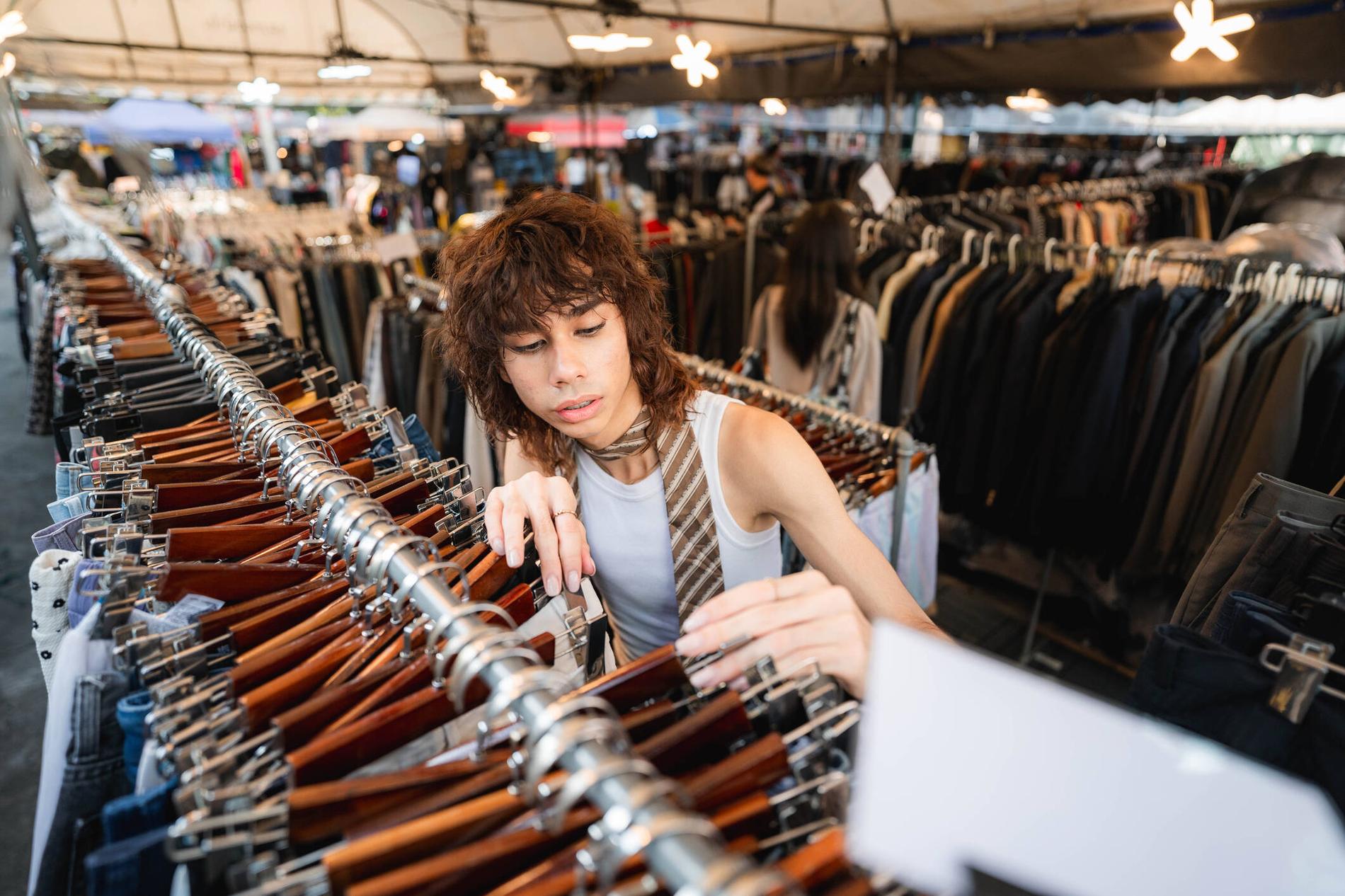
Top Tips for Thrifting Clothes as a Student

Tabitha Woolcott
31 July 2026 • 9 min read
About the author: Hiya, I’m Tabitha Woolcott! I’m originally from Brighton but currently live in Norwich, where I’m studying American Literature with Creative Writing at the University of East Anglia. I’m a big old book nerd, a radio DJ at UEA’s student station, and fashion fanatic who can’t resist a charity shop.
Student leases are ending all over the country, triggering the annual surge of unwanted clothes hitting charity shops. If you, like me, have recently enacted some serious closet culling and are looking to refresh your style a bit for the next academic year, the prime time for thrifting is now!
Thrifting is a bona fide part of student culture, and for good reason. Unique clothes, low prices, good for the environment? Yes please! As fast fashion prices (and outputs of waste) grow eye-wateringly high, pre-loved clothes are the smart, sustainable choice – plus, you’re liable to find hidden gems that will set your style apart from the rest.
But finding those hidden gems isn’t always as easy as walking into your nearest AgeUK. Don’t let this put you off! Check out these top tips for thrifting, and make the next academic year your most fashionable yet.
Top tips for thrifting clothes as a student
Click through for my tips and tricks for thrifting clothes as a student:
✅ The difference between charity shops and vintage shops
✅ Top tips for thrifting clothes
✅ What to avoid when thrifting
✅ How to use Vinted to find hidden gems
✅ To sum up
Charity shops vs vintage shops 🤷♀️
First things first, you’ve got to figure out where you’re headed. Most cities contain both charity shops and vintage shops – the distinction is important!
Vintage shops
Vintage shops are for-profit small businesses offering curated selections of vintage, retro and antique clothes. There are a few benefits to shopping here: their curation means garments are likely to be in better shape on the whole, they tend to contain less fast fashion, and they’re a great place to find designer labels for slashed prices. Older clothes tend to be higher quality, too, so you can be sure you’re getting a well-made, long-lasting garment for your money.
The price point is higher at vintage shops – usually double or triple what you’ll pay in charity shops. Still, if you’re willing to invest in an item’s quality (think winter coats or graduation attire), definitely check out your local vintage shops! Many shops also vend online: the London-based Rokit is my favourite to peruse from bed, and I’m partial to Second Wave Vintage when I’m looking for particular labels.
Charity shops
Charity shops are volunteer-run, with proceeds going to charity, and they keep their prices low to clear out large volumes of donations fast. They’re generally more ‘hit or miss’ than vintage shops; less curation means less quality control. But with the huge variety of items donated, it’s possible to find hidden gems for incredibly cheap, perfect for students on a budget!
Oxfam, Cancer Research and the British Heart Foundation are the UK’s most major charity shops, found everywhere across the country, but I’ve found that smaller or more local charities tend to have better offerings at their branches, due to a lower volume of donations. Shoutout to the insane Helmut Lang top I found at Norwich’s own EACH!
(Interested in what Norwich has to offer in terms of second-hand shopping? Check out my blog post on the best charity shops in Norwich.)
Top tips for thrifting clothes as a student 💡
What’s the best time to arrive at a charity shop? Some swear by arriving early in the day for the best finds, but I’ve found this doesn’t really make a difference unless you’re hitting a very central area. What tends to have more of an impact is the time of year you’re thrifting at. Student move-out time (July to August), the New Year and the ends of every season are popular periods for clear outs, so stock is fresher.
If you’re living in a city centre, taking a trip further out into the suburbs or neighbouring towns can be a great hack. Less-urban charity shops tend to be cheaper and less picked-over (by savings-savvy stylists like you) – if you’re up for the trek, this is often where the best gems are found. Last summer I was searching for a fitted short-sleeved blouse, but wasn’t satisfied with any of the offerings from high-street retailers; an Oxfam in my tiny West Sussex hometown came to the rescue with the perfect baby blue number, priced at just £2!
Visualisation and focus are the two main skills you’ll need to tap into for a successful thrift trip. Just having an aesthetic in mind isn’t enough; when you’re searching through lots of stuff, you can cut out the noise quickly if you know what types of fits, colours, textures and brands you’re looking for. Pinterest is my essential tool for this: I love to pull up my boards for reference while thrifting, to ensure the items I purchase fill an actual gap in my wardrobe and mesh well with things I already own. That’s the best way to combat buyer’s remorse!
What to avoid when thrifting 🙅♀️
Pre-loved clothes can vary hugely in quality, so be scrupulous when you’re searching. Some rips can be mended or loose buttons replaced (and I definitely recommend getting handy with a needle if you care about making your clothes last), but while flaws like bobbling, flaking and fraying hems may not keep you from buying a cool piece in the moment, they can definitely prevent you from reaching for them in the future. Condition can seem like an afterthought when you’re sifting through lots of stuff, but it’s essential to consider! You’re likely to feel more confident in a well-made item that feels like a ‘splurge’ (but isn’t!) than a unique find that’s falling apart.
Another top tip for avoiding regrets: don’t purchase items that are ‘nearly perfect’. Perhaps you’re looking for a staple denim jacket: you’ve found one in your ideal wash, but the length is wrong, or the shoulders are a bit broad. Don’t bother! You won’t end up wearing it, and the search will begin all over again…
Thrifting online: a student guide to Vinted 📱
Getting savvy with virtual second-hand marketplaces like Vinted and Depop is perhaps the greatest hack of all when it comes to sourcing pre-loved clothing. Uber-convenient, with endlessly filterable results you can scroll through at home, they hugely cut through the time and physical effort required to sift through shops in person. These platforms can take some getting used to, though, and might be overwhelming when you first jump in – with over 800 million items listed, it’s a step up from even the most chaotic charity shops! Luckily (or unluckily for my bank account) I’m a self-proclaimed Vinted pro, and I’ve developed a few tips to make your searching easier.
So you’ve opened Vinted, but you’re struggling to navigate a baffling wall of random items you’re not interested in? The trick is to make the platform do the work for you by quickly taking the reins of its algorithm. Doing your homework helps out here – start out with some inspirational window-shopping on regular retail sites, or on social media sites like Pinterest or TikTok, while noting down all the terminology you come across in hashtags and captions. Collect your favourite eras, brands and named ‘aesthetics’ (like ‘office siren’ or ‘cottagecore’), and find out the actual names and specifications of items you’re interested in: ‘pin-tuck fitted blouse’, ‘asymmetrical detailing’, the kind of descriptions found in product listings. Then you’ll be ready to search!
Base your searches around the terminology you’ve harvested, and use the filter tools to narrow things down further by colour or size. Start out by favouriting everything you’re into, even if the item is out of your price range. Check out sellers’ other listed items, or Vinted’s recommended ‘similar items’ page included under each listing. Once you’ve demonstrated your specific interests, your algorithm will quickly catch up: newly posted or trending items matching your searches will jump to the top of your feed, and you’ll also see recommendations for other great finds that pair well with your favourites, or fall under the same aesthetic ‘umbrella’.
Since I tailored my Vinted feed, there’s absolutely nothing I can’t find second-hand. Vintage heels for graduation, the perfect black woven holiday bag, alternative ‘90s French gems (my ultimate fashion favourite) which sell for crazy prices elsewhere – just a few minutes of scrolling, no fast-fashion prices, and no chaotic malls!
To sum up ✍️
Vintage shops have a more curated stock than charity shops, but they tend to be more expensive.
Still, vintage items are often better made and will last much longer than fast fashion.
Try checking out charity shops in suburbs or small towns as you can find some real hidden gems here.
Don’t buy something for the sake of it; make sure it’s in good condition, that it ticks all the right boxes, and that it fits in with the rest of your wardrobe.
Vinted and Depop are your new best friends when it comes to second-hand shopping – you just need to learn how to curate your feed.
Searching for student accommodation?
If you’re still looking for a new student house – maybe one with a slightly bigger closet – UniHomes makes house-hunting a breeze. Check out our range of student accommodation options today!
If tightening your budget is a goal, you can’t miss our super convenient bills packages, too! We bundle your gas, electricity, water and Wifi into one simple monthly payment that’s split fairly between you and your housemates, so you can spend less time stressing about utilities and more time focusing on uni. Click here to get a quote.
This post is part of the UniHomes Content Ambassador programme, where current students across the UK share tips about student life in their city to help you make the most of your time at uni. Like these guides? Add UniHomes as a preferred source in Google with just one click by checking the box to see more expert content from our student writers!
The views and opinions expressed in these blogs are those of the UniHomes Content Ambassadors and do not necessarily reflect the opinion of UniHomes. UniHomes accepts no liability for the content of these Student Blogs.